
Podcast: Play in new window | Download
Subscribe: RSS
The 2026 United Football League (UFL) spring football campaign passed the halfway point recently.
Through six weeks of the league’s ten-game regular season, each UFL team is now on a similar path.
The eight spring football franchises are experiencing a decline in attendance at the midway point of the 2026 season.
The UFL replaced teams in San Antonio, Detroit (Michigan Panthers), and Memphis this year. Those franchises were relocated to Louisville (Kings), Columbus (Aviators) and Orlando (Storm).
A primary reason for leaving San Antonio, Detroit, and Memphis was that all three teams played in large traditional football stadiums. Those facilities cost the UFL a lot of money to lease.
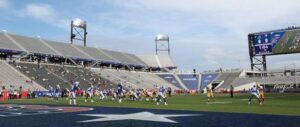
Small crowds of 10,000 fans or less for games played in 50,000 seat facilities looked really bad on national television, too.
This new trio of UFL teams is playing their home games in soccer stadiums with seating generally less than 20,000. The optics showing a crowd of 10,000 inside of a smaller football venue looks more visually appealing to home television viewers.
Let’s count that as a win for the UFL. However…
The average attendance for those three new UFL franchises isn’t exactly turning heads, either.
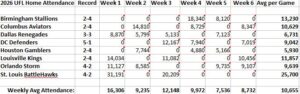
Through game 6, the entire league is averaging a little bit more than 10,000 fans per football home game. Half of the UFL franchises (Houston, Dallas, defending champion DC, and Orlando) still can’t pull more than 10,000 per outing to their games.
St. Louis (which led the league in attendance in each of the UFL’s first two seasons) is averaging 25,700 per game to lead the league in 2026.
Below is a chart showing the attendance for each UFL team through Game 6 last weekend.
Ticket prices for UFL games across the league are relatively cheap
You can buy a 20-yard line ticket to this Saturday night’s Birmingham Stallions home game against the Dallas Renegades for $15 and receive a free t-shirt, too!
Let’s say that the average ticket price in Birmingham was $25. If the Stallions attract a crowd of 15,000 to this Saturday night’s game, that translates into ticket revenue of $375,000 for the week.
Over a five game home schedule, Birmingham would generate $1.85 million in ticket revenue.
With a roster of 50 players making an average of $60,000 per season, the personnel cost for the Stallions is $3 million. Let’s also estimate that total expenses for the Birmingham UFL franchise (lease payments, coaching salaries, travel, game day costs and administrative expenses) are (conservatively) another $3 million.
Now, multiply that revenue shortfall by eight UFL franchises. The numbers simply don’t work.
What about the television ratings for the UFL?

The television ratings for UFL games compared to the NFL are similar to upstart LIV Golf when compared to the PGA Tour.
UFL spring football brings about 5% of the average number of weekly television viewers which the NFL attracts for its games in the fall.
Television ratings in 2026 for the UFL have been difficult to quantify week-to-week. In general, the four weekly televised games have settled into a predictable pattern.
FOX (one of the minority owners of the UFL) is into Year #2 of providing a Friday night prime-time football game.
The six Friday night games in 2026 have averaged 638,000 viewers.
For Friday, May 3, the UFL spring football game on FOX (which attracted 670,000 viewers) finished in dead last behind primary competitors CBS, ABC, and NBC.
The CBS Friday night line-up averaged over 4 million viewers. ABC attracted less than three million. NBC (which featured horse racing from Churchill Downs) came in at less than 2 ½ million last Friday night.
FOX cannot be pleased about getting curb-stomped in the TV ratings every Friday night for two straight years. The network’s Friday night UFL spring football games have been unable to crack the one million viewer mark one single time in two years.
A recent week of prime-time television ratings showed the FOX Friday Night UFL game finishing in 162nd place.
In addition to trailing the four primary networks, the FOX Friday UFL game lagged behind top cable television offering on Fox News, ESPN, MSNow, TLC, HGTV, TBS, USA Network, Comedy Central, ESPN2, Food Network, Bravo, Hallmark, CNN, Discovery, History, and A&E.
That stinks.
ABC’s Saturday afternoon UFL games have shown the strongest viewer interest. Last week’s Dallas Renegades at DC Defenders drew the league’s highest television audience of the season as 1,050,000 watched the game on Saturday afternoon, May 2.
The television networks need the UFL to consistently attract more than one million weekly viewers
Advertisers want their product to be seen by the greatest number of people in their desired demographic. Football traditionally delivers a predominantly male buying audience and is highly coveted by certain advertisers.
UFL games are shown on the “big” networks like ABC, FOX, and ESPN.
That means that there are zero excuses why football fans are not finding and watching the games. It is proof that most viewers simply aren’t interested in the product.
Has the UFL been targeting the growing online gambling market to stay afloat?

Like it or not, online sports gambling has been growing quickly. Unfortunately, many college students are becoming increasingly involved with online gambling.
The UFL football games (especially those shown every Friday night in the spring) represent “the only game in town” for some bettors seeking football-oriented gambling opportunities.
It’s impossible to know whether the UFL or the owners of online gambling companies are actively pursuing younger audiences to wager on UFL spring football games.
The lack of growth in the UFL’s television audience from year-to-year seems to indicate that the gambling factions are not having a sizable effect.
Who is Mike Repole, and why has he become “Mr. UFL?”

The first two seasons of the UFL were financially underwritten by an ownership team of FOX Sports (50%) along with wrestling/media star Dwayne “The Rock” Johnson, his ex-wife Dani Garcia, ESPN, and RedBird Capital Partners.
The original set of owners has lost tens of millions of their own money during the first two UFL seasons.
Last summer, billionaire entrepreneur/promoter Mike Repole became a partner in the UFL, too. He purchased an undisclosed interest after the 2025 season ended.
Repole quickly jumped-in trying to remake the league with several of his own ideas.
The enthusiastic Mike Repole is about as subtle as the Kool-Aid guy bursting through the wall.
He has already told Oklahoma City that they will be granted a UFL franchise in 2028 once the city’s new soccer stadium is completed. Repole wants the spring football league to double in size to 16 teams within the next few years.
It was Mike Repole’s idea to move three franchises to Columbus, Louisville, and Orlando this season. He also spearheaded the UFL’s move into smaller soccer venues in 2026 to save cash and look better on television.
The 57-year old Mike Repole has also jousted with fans of the 2024 UFL league champion Birmingham Stallions franchise, too. He let it be known that the Alabama-based franchise would be moved if local supporters didn’t show significant improvements in game attendance this season. (Note – the Stallions are #2 in UFL average attendance entering Week #7)
Yes, Mike Repole has been a virtual one-man crusader for the UFL over the past year.
Try as he might, the vital signs for his beloved UFL in 2026 are still the same.
The UFL remains on life support

Only the deep pockets of the UFL’s investors has kept this patient from an expected death.
Let’s forget about the size of the football stadiums. When only 10,000 paying fans show up to watch any professional sport with massive fixed costs like football, the sports league is going to lose tons of money and eventually cease to exist.
Perhaps the UFL has been hoping to attract some type of life preserver from the National Football League. It’s not that the NFL couldn’t have invested in the UFL from Day 1, though.
It simply chose not to. The NFL has watched any number of spring pro football leagues come and go. That’s because football fans aren’t interested in the product.
The NFL wisely understood that they “own” the fall sports calendar.
NFL franchise owners want football fans to be salivating in anticipation of the league’s return every year.
Remember that the NFL has already been through this with the American Football League back in the 1960’s.
Once the AFL achieved significant momentum with football fans and grew its television ratings, the NFL purchased their youthful competitor to end the challenge.
The UFL’s presentation on the field and for home television has been exceptional. Games (though still a bit too low-scoring for me) are often entertaining to watch.
I will award the UFL an “A” for effort.
This spring football league and several others have tried mightily to get their product to take root. Football fans simply have not reciprocated with an endearing love for spring pro football.
The UFL’s owners have every right to lose as much money as they desire hoping that their football league will eventually gain traction with the public.

When and if that ever should happen, the NFL is likely to respond.