
Podcast: Play in new window | Download
Subscribe: RSS
One week ago, the state of Louisiana’s Legislative Auditor’s office released its annual fiscal review of Grambling State University’s athletics program for the year ending June 30, 2025.

The school was cited for a few audit irregularities and quickly announced that changes were being made. That wasn’t the biggest news, though.
Grambling’s athletics department lost $5.1 million for the fiscal year ending June 30, 2025. Revenues were reported at $9.2 million versus annual expenses of $14.3 million.
In percentage terms, Grambling’s revenue was only 64% of the amount needed to sustain the athletics programs at the current level.
Grambling wasn’t the only north Louisiana public university whose athletics spending exceeded revenue last year
The same Louisiana Legislative Auditor also filed reports earlier in 2026 for Louisiana Tech University, Northwestern State University and the University of Louisiana at Monroe.
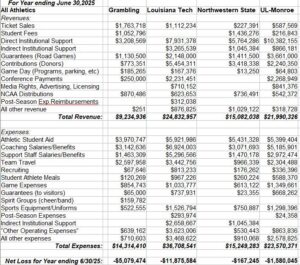
Each of these four football-playing state universities located north of Alexandria reported losses in their athletics programs for the year ending June 30, 2025. Grambling’s massive deficit grabbed the recent news headlines, but there is a troubling commonality among Louisiana public schools not named LSU.
Louisiana Tech recently cut an expensive deal (rumored to be in the vicinity of $8 million) in order to exit Conference USA and join the more geographically-suitable Sun Belt Conference.
That move may turn out to be prudent for the Bulldogs over the long-term. Louisiana Tech’s annual travel expenses as part of Conference USA totaled nearly $3.5 million. Nearby Sun Belt rival UL-Monroe’s travel costs for the same year were $2.3 million. Louisiana Tech is expected save $1 million or more annually on its travel expenses beginning this fall by moving to the Sun Belt Conference.
Let’s look under the hood at each of these four universities’ athletics spending. We’ll finish with a few common sense (cheap) ideas on how to achieve break-even in the future.
Grambling State University – 5,200 students (2024/2025 school year)
Grambling is nationally known for its athletics and its exceptional marching band. It was bit surprising to learn that Grambling’s football program had lost $2.5 million in the most recent year. That amounted to about 50% of the athletic department’s annual deficit of $5.1 million.
The football team’s travel costs of $1.1 million last fall were higher than all three of the other north Louisiana pubic schools.
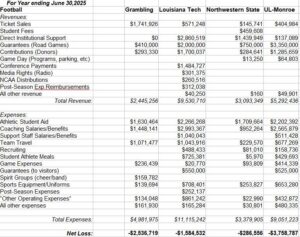
The expense summary also showed nearly $160,000 was spent to cover the costs of the school’s spirit groups (for one or more road trip performances).
Grambling’s men’s and women’s basketball teams each posted losses in excess of $900,000 for the most recent year.
Grambling (like Northwestern State) participates NCAA’s FCS small college football division. The G-men play in the Southwestern Athletic Conference (SWAC).
Louisiana Tech University – 12,145 students (Fall, 2025)
The Bulldogs are based in Ruston. Louisiana Tech’s campus is less than six miles east of Grambling via Interstate 20. The Bulldogs have been competing in Conference USA and a part of the NCAA FBS major college football division. As mentioned earlier, Louisiana Tech moves into the Sun Belt Conference this fall.
Audit results for Louisiana Tech’s athletics department last year showed a loss of $11.875 million.
Football lost “only” about $1.6 million for the year. Louisiana Tech’s men’s and women’s basketball teams each ran a deficit of about $700,000 apiece. Other competitive sports at Louisiana Tech lost another $2.6 million. The school’s income statement showed “non-program specific” athletic costs with a $6 million shortfall.
As noted earlier in this report, Louisiana Tech’s overall travel costs playing in far-flung Conference USA were easily the highest in the group. The Dogs’ annual total of $3.5 million for travel exceeded Grambling ($2.6 mm), UL-Monroe ($2.3 mm) and Northwestern State (less than $1 million).
Northwestern State University – 8,402 students (Fall, 2025)
The Demons from Natchitoches, Louisiana came the closest to break-even within its athletics programs among these four state schools. Northwestern State participates in the NCAA’s FCS small college football division in the regionally-aligned Southland Conference.
Northwestern State posted a relatively benign loss of $167,245 for the fiscal year ending June 30, 2025. The Demons’ men’s basketball program ran the largest deficit at more than $300,000. The football team came up short by $280,000.
Noteworthy, Northwestern State collected nearly $1.5 million in annual student fees to help support athletics. That was about 10% of the school’s athletics spending. It was the highest total among these four north Louisiana state schools.
University of Louisiana at Monroe (ULM) – 8,678 students (Fall, 2025)

Sun Belt Conference member ULM (like Louisiana Tech) competes in the NCAA’s FBS major college football division. ULM is expecting to benefit from Louisiana Tech’s arrival in the Sun Belt Conference this fall with increased attendance and revenues expected at home games in all major sports.
The Warhawks’ athletics budget is the smallest among the NCAA’s 136 FBS major colleges. ULM’s overall school budget has been prone to massive shortfalls in recent years, too. That means that ULM’s $1.5 million athletics department loss in fiscal year 2025 is much harder to cover.
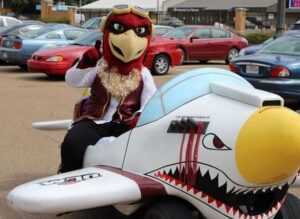
Audit results showed the UL-Monroe football program lost a whopping $3.8 million in the most recent report. The Warhawks’ men’s and women’s basketball teams lost a combined $2.5 million. Ouch!
The school’s institutional support has kept the ULM athletics department afloat for years. Significantly higher fan support for the Warhawks football and basketball programs is needed immediately. Otherwise, the school may have no other choice but to consider returning to the NCAA FCS small college athletics division.
A few suggestions from SwampSwami to achieve fiscal break-even

These four north Louisiana state universities are located within 100 miles of each other. Each school is a very large and important employer in its home city.
These state schools must immediately address their athletics spending and move quickly toward achieving fiscal balance. At the same time, they must also work harder and more creatively to raise sports revenues over the long-term to grow the athletics programs.

First things first – Take immediate cost cutting measures – The simplest and fairest way is to voluntarily reduce athletics spending by cutting a certain percentage across the board. That could come in the form of job reductions or, perhaps, an across-the-board pay cut for staff making more than $30,000 per year. For example, a 5% mandatory spending reduction in Year 1 may spur some voluntary budget trimming beyond that level. Yes, this likely means one less assistant coach, one fewer support staffer, one less charter flight, etc. The athletics departments must take a hard look at streamlining operations. Learn to do more with less.
Refuse to play long-distance road games unless the school earns a significant profit by participating – UL-Monroe’s football team hits the road for at least two “Clobbering Time” payday games every season.

They are often paid more than $1 million to play at large universities such as LSU, Texas A&M, and Alabama with huge stadiums. ULM receives more money from some of these massive “visitor” paychecks than playing a home game in front of a sold-out stadium. There are also downsides from being on the receiving end of a couple of massive road losses every season, too. The football team and local fans can become a bit demoralized about the team’s chances for the remainder of the season.
Now, let’s try to grow the revenue side with a few cheap ideas
Stimulate increased student, alumni, and hometown support – Student and local support for the athletics programs within each of these four communities (Grambling, Ruston, Natchitoches, and Monroe) must improve. Local fans want to see their sports teams having a chance to win more than they lose. Identify sports which are cost-effective and give the school the best chance to hang a new (and long overdue) championship banner.

Success in any of the major sports at these four schools can go a long way in rejuvenating and expanding the school’s athletic support base.
Improve local marketing and promotion – It may sound corny but handing out free tickets to youth at local elementary, junior high school and high schools gets parents and guardians to purchase tickets, too. A positive game day experience for that youth can plant a valuable seed about attending that college some day. Each of these four north Louisiana public universities have thousands of empty seats available at football and basketball games. A purposeful campaign to encourage and engage more youth at nearby college sporting events will pay future dividends.
Inject more game day excitement – Utilize the pregame, quarter breaks, halftime, and post-game times to get fans more engaged. Experiment with creative new (and inexpensive) ideas to keep the game experience fresh for all ages of fans.

They will be more likely to return if they are having more fun at the games.
Relentlessly promote ahead – There are only a few home football games played each fall. Make each game special with its own promotion. There are, perhaps, twenty home basketball, baseball or softball home games, too. Give thought as to how to make each home game unique for fans.

Target every recent (last few years) ticket purchaser by sending a weekly email. Remind them of the school’s upcoming weekly sports schedule, special promotions, and discounts. Utilize all types of social media to reach a wider audience to spread the word about upcoming college athletic events and team opponents.
Depend on your own athletics staff to get the word out – Sadly, we live in a world with fewer and fewer exceptional local newspapers. It is incumbent on each school’s athletics department to take an aggressive role in publicizing and promoting all ticket-based sporting events. Fans want to know about the school’s upcoming games and events, so take the initiative!