

Podcast: Play in new window | Download
Subscribe: RSS
We are in that brief summertime window where college athletics have gone on vacation.
The men’s and women’s College World Series ended last month. Football season begins again in late August.
I have been reflecting on the ever-changing landscape of college athletics.
Even just twenty years ago, the major college sports conferences looked a whole lot different than they do today. Schools have been shifting to new conference locations primarily to maximize revenues.
A few have switched conferences primarily to reduce expenses (I’m looking at you, Louisiana Tech!)
The question remains as to whether the recent decades of musical chairs has resulted in improvements for college athletic fans and athletes? Or have these changes primarily benefited the wallets of major universities and the media companies who quietly wink and nod after bigger TV markets have been added to the portfolios of the largest conferences.

Let’s jump into the Wayback machine today and return 20 years to 2006. We will take a look at each major college athletic conference as it was in 2006 and how it is structured today in 2026.
Have these additions been for the better or worse for each conference?
Today, let’s examine the top four (by money) major football conferences. We will review the group of “mid-major” conferences in my next report.
Southeastern Conference (SEC)
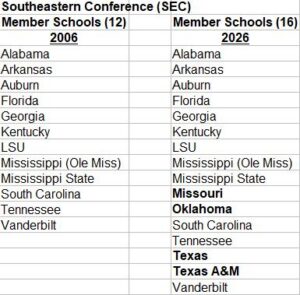
New teams: Missouri and Texas A&M (2011); Oklahoma and Texas (2024). Interestingly, each of those four teams moved from the Big 12 Conference to the SEC.
Analysis by Team:
Missouri – has been a geographic misfit in the SEC from Day 1. The Tigers have not competed at a high level in most sports nor do they have a lot of trophies to show for the past 15 years in the SEC. Grade: D
Texas A&M – made a lot of sense coming to the SEC in 2011. The Aggies needed to move along from its constant obsession about being compared to intrastate foe “Texas University”. SEC leaders were able to snag the huge Houston and Dallas-Fort Worth TV markets. A&M has proven it “belongs” in the SEC over its 15 years in the league by earning several league titles and staying relevant annually. Grade: B
Oklahoma – The Sooners played in the College Football playoffs last year and just claimed the men’s College World Series title in June. OU’s long history of athletic success has already been felt around the SEC. Grade: B+
Texas – The Longhorns are annually contending for the College Football Playoffs in recent seasons. Texas also brought the growing San Antonio and Austin TV markets into the SEC. The Longhorns have quickly become top SEC competitors in basketball, baseball, and other sports. Grade: B+
SEC overall grade for expansion: B
Big Ten Conference (Big Ten)

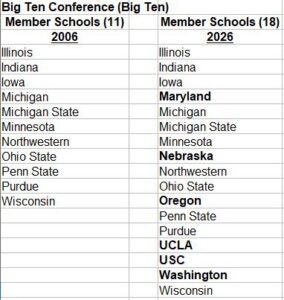
New teams: Nebraska (2011); Maryland and Rutgers (2014); Oregon, UCLA, USC, and Washington (2024).
It took a long time for the stodgy Big Ten Conference to finally invite Penn State to become its 11th team in 1990. Since that time, the poorly named Big Ten has grown to 18 schools today. The league picked-up several large TV markets in New York City and Philadelphia (Rutgers), Washington DC/Baltimore (Maryland), Los Angeles (UCLA and USC), and Seattle (Washington). Those new schools have produced relatively little in terms of sports titles for the conference, though.
Analysis by Team:
Nebraska – The Cornhuskers left the comfy confines of the Big 12 Conference in 2011 and quickly saw their national stature in sports take a beating in the Big Ten. Despite lofty expectations, Nebraska has been a disappointment. Grade: D
Maryland – Ditto. Just substitute “ACC” for “Big 12”. Grade: D
Rutgers – Rutgers was lousy at most major sports prior to joining the Big Ten. They were added to the Big Ten simply to attract television viewers from the New York City and Philly TV markets. Athletically speaking, Rutgers has been a Big Ten bust. Grade: F
Oregon – The Big Ten’s raid of the former Pac-12 snagged one of the nation’s top football teams in Oregon. The Ducks have given the Big Ten a much needed bolt of energy. However, I can’t give a top grade to Oregon when its athletes must travel thousands of miles just to participate in Big Ten events. Grade: C+
UCLA – The Bruins’ women’s basketball and softball teams have been been excellent. However, the men’s sports programs haven’t made much of a dent in the Big Ten yet. Grade: C
USC – There were lofty expectations for the Trojans’ football team. They have under-performed. Like UCLA, USC has not been a difference maker in the Big Ten. Grade: C-
Washington – The Huskies’ football team has regressed the past two years with a 14-11 overall mark. Washington’s other sports teams have been nearly invisible in the 18-team Big Ten Conference. This is yet another school spending a ton of money on jet fuel. They are forcing student/athletes to travel across the country to play in athletic events just to grab more money from television. Grade: D-
Big Ten overall grade for expansion: D-
Atlantic Coast Conference (ACC)

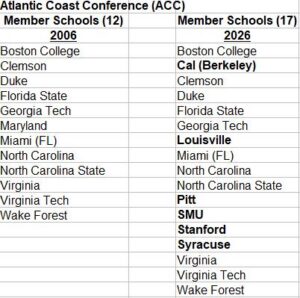
New teams: Pitt and Syracuse (2013), Louisville (2014), SMU, Stanford, and Syracuse (2024)
Exiting team: Maryland (2014) to Big Ten
*Notre Dame: The Irish joined the ACC in 2013 but remained independent in football.
The current 17-team Atlantic Coast Conference has, by far, the worst geographic fit of any major college conference in America. Twenty years ago, the ACC’s 13 teams (Maryland has since left) were located along the Atlantic coast. Adding SMU (Texas) and West coast entries Cal and Stanford in 2024 has been one of the most puzzling decisions in recent years.
Analysis by Team:
Louisville – This school (since 2013) has been surprisingly competitive in football but surprisingly non-competitive in men’s basketball recently. Overall, the Cardinals have been a solid addition to the ACC. Grade: B+
Syracuse – The Orange (coming aboard in 2013) has produced just four winning seasons in football after 13 years in the ACC. Some early ACC basketball success has faded in recent years. Grade: C-
Pittsburgh – Pitt (which arrived in 2014) had a good run in football a few years ago with Kenny Pickett running the offense. Otherwise, their addition to the ACC has been “OK” at best. Grade: C-
Cal (Berkeley) and Stanford – these two Pacific Coast schools (added in 2024) have brought zero titles to the ACC since joining the league. They remain a waste of jet fuel. Grades for both schools: F
SMU – The Mustangs effectively bought their slot in the ACC in 2024 with the help of their wealthy financial backers. SMU made it into the 2025 College Football Playoffs but hasn’t been a factor in other sports. Grade: D+
*Notre Dame – The Irish baseball team made it into the College World Series in 2022. Notre Dame’s financially prudent but quite selfish decision not to participate in football in the ACC comes with a marked-down score. Grade: D
ACC overall grade for expansion: D
Big 12 Conference (Big 12):
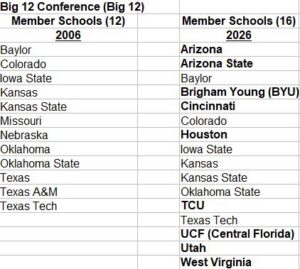
Only seven of the Big 12 Conference members remain from 2006. Within that group, Colorado left the Big 12 for the Pac-12 in 2011 but returned in 2024.
Analysis by Team:
Arizona – The Wildcats came to the Big 12 in 2024 as a refugee from the dying Pac-12 Conference. Arizona went 9-4 in football last season. It’s too early to give the Cats a good grade. Grade: C
Arizona State – Same story as Arizona. Grade: C
BYU – The Cougars came into the Big 12 in 2023. They have rolled-off 11-2 and 12-2 football records in 2024 and 2025. The BYU basketball team has appeared in the NCAA tourney in all three seasons after joining the Big 12. Despite its geographic distance from other longtime Big 12 members, Brigham Young has been a positive addition to its new conference. Grade: B+
Cincinnati – They entered the Big 12 in 2023. The Bearcats haven’t been a major sports factor in their three years in the conference. Cincy has been a good geographic fit for the Big 12, but a sports dud. Grade: D-
Houston – The Cougars also came into the league in 2023 along with the valuable Houston television market. The Coogs have been competitive in football and a regular national championship contender in men’s basketball. U of H has been a solid addition to the Big 12. Grade: B
TCU – Texas Christian joined the Big 12 in 2012. In addition to bringing the Dallas-Fort Worth TV market into the league, the 2022 Horned Frogs’ football team played in the national championship game (and lost). TCU’s other athletic programs have been regular contenders in the Big 12. Grade: A-
UCF – Central Florida (added 2023) hasn’t posted a winning season in football in three years in the Big 12. The other sports teams haven’t been very competitive, either. This school was added primarily due to its enormous size (70,000 students) and the Orlando television market. Despite those pluses, the school is 1,000 miles east of Houston (the nearest Big 12 city). This addition has been puzzling since Day 1. Grade: F
Utah – The Utes football team finished 11-2 in 2025 (the school’s second year as part of the Big 12). Utah’s sports programs are generally quite competitive and bring enthusiastic fans. Grade: B-
West Virginia – Mountaineers entered the Big 12 back in 2012. In the past 14 years, West Virginia has posted a winning football record 50% of the time. Like Utah, this is a school with passionate sports fans who have been a plus for the Big 12. Grade: B-
Big 12 overall grade for expansion: C+
Conclusion – SEC, Big Ten, ACC, and Big 12 conferences

After the questionable addition of Missouri in 2011, the SEC’s expansion to add both Oklahoma and Texas in 2024 has made their conference a bit stronger.
OU and Texas jumped from the Big 12 to the SEC in 2024 after huge piles of money were being pushed in their direction to incentivize the move. It still saddens me that these two long-time anchor tenants of the Big 12 Conference aren’t around any longer.
Speaking of the Big 12, let’s give that conference credit for adding several new schools within relatively proximity of the league’s Midwestern stalwarts.
However, the addition of UCF (Central Florida) made absolutely no sense in 2023. It is still puzzling today.
Both the Big Ten and ACC moved to add schools located west of the Mississippi River in recent years. The Big Ten’s addition of four former Pac-12 universities still feels odd. Meanwhile, Cal and Stanford have brought zero value to the ACC.
Instead of buying their way into the ACC, SMU should have remained patient. The Mustangs could have bought their way into the Big 12 at some point and be competing with nearby TCU and other regional rivals instead of jetting their athletes up and down the Atlantic seaboard.
All in all, expansion has generally served to water-down the four major college conferences – at least on the playing field. The recent moves have all centered on universities pocketing more money from television and media companies.
Let’s examine the American, Conference USA, Mid-American, Mountain West, and Sun Belt conferences during in next visit!