
Podcast: Play in new window | Download
Subscribe: RSS
The previous post covered my grades on how the strength of today’s four largest college athletic conferences compare with their previous versions twenty years ago in 2006.
Here’s a brief recap.
In my estimation, only the SEC (which expanded from 12 to 16 teams over that 20 year period) has shown an upgrade in competition levels since 2006. I awarded the SEC a “B” grade.
The Big 12 (which lost four of its prominent members to the SEC) received a C+ for their nimble addition of several relevant regional sports schools.
A “D” grade was handed down to the Atlantic Coast Conference. Their nonsensical addition of West Coast newcomers Cal (Berkeley) and Stanford in 2024 crashed the ACC’s overall score.
Speaking of lousy grades, I awarded a D- to the Big Ten Conference as its recently-annexed properties have resulted in a BIG thud. From the east (Maryland and Rutgers) to the west (Nebraska, Oregon, UCLA, USC, and Washington), the Big Ten’s new coast-to-coast configuration has failed to improve this conference for either sports fans or student/athletes.
How have the five mid-major conferences fared with recent expansion issues?
These other conferences (nicknamed the “Group of Five”) can be quite entertaining but rarely win national championships. They must compete against the “Big Four” major conferences featuring the wealthiest college sports programs.
American Athletic Conference (AAC)
The AAC has only been around since the year 2013. There were 10 initial AAC members and now 14 in 2026. Only Memphis, South Florida, and Temple remain from 2013. The ACC raided Conference USA to obtain several of its new members.
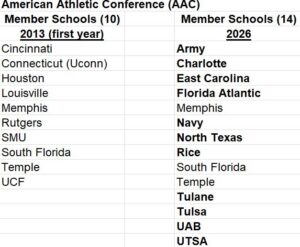
Army and Navy – What’s not to like about these two additions? They bring the focus of the entire college football world to their annual game played in early December. Grades – A
Charlotte – The 49ers have been perpetual cellar dwellers in most sports. Charlotte, North Carolina sports fans are more likely to follow UNC, Duke, and Clemson. Yawn. Grade – D-
East Carolina – The Pirates have made the NCAA baseball playoffs ten times since 2013 and have occasionally contended for the AAC title in football. A hearty fan base makes ECU a fun place to watch sports. Grade – B
Florida Atlantic – A member of the AAC since 2023, this school is best known for its men’s basketball team and having a great beach nearby. Sadly, most local sports fans don’t give a hoot about the FAU Owls yet. Grade – C-
North Texas – The Mean Green had a brilliant 12-2 football season in 2025 in the school’s third year as part of the AAC. The other sports are lagging behind. Grade – C
Rice – Another third year AAC member, the Houston-based Owls have been an athletics flop in their new conference. Grade – D
Tulane – Green Wave football program has rejuvenated Tulane athletics down in the Crescent City. Unfortunately, the remainder of the school’s sports teams rarely lead the AAC. Grade – C
Tulsa – Golden Hurricane football and men’s basketball programs have been on the decline in the past decade. That’s a shame, because Tulsa fans desperately want to get behind the city’s lone major college athletics team. Grade – C-
UAB – Try as I might, I’m having trouble remembering any recent sports successes for the Blazers. Grade – D-
UTSA – Like Tulsa, the Roadrunners have the entire San Antonio market ready for their athletics programs to take off. Other than some recent success in football, UTSA sports still appear to be taking a siesta. Grade – C-
AAC overall grade for expansion: C-
Conference USA (C-USA)
I am not going to provide individual grades to Conference USA member schools. It is not their fault that C-USA management has done such a lousy job of keeping this conference together and relevant in major college sports.
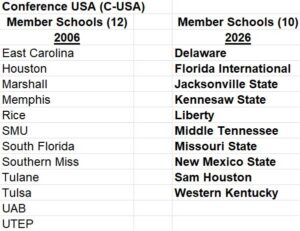
The conference has seen a 100% turnover in the past 20 years.
Schools being added have generally been former FCS top teams such as Delaware, Sam Houston, and Jacksonville (AL) State.
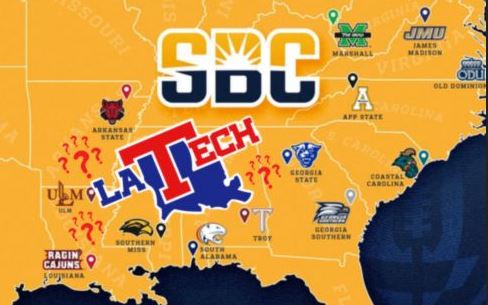
Things have declined so badly in Conference USA (“How badly have they declined?”) that longtime member Louisiana Tech recently agreed to pay a reported $8 million to buy its way out of C-USA. The Bulldogs’ jubilant athletic department and fans are rejoining the Sun Belt Conference this fall. Louisiana Tech will save more than $1 million annually in travel costs formerly required to travel to schools within the far-flung Conference USA.
Longtime C-USA holdovers Western Kentucky and Middle Tennessee State deserve a better fate. Save your money and call the Sun Belt in a couple of years!
C-USA overall grade for expansion – F-
Mid-American Conference (MAC)
In contrast to Conference USA, the MAC has remained remarkably stable for the past 20 years.
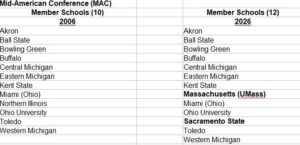
Eleven of the dozen MAC members in 2006 remain a part of the conference today. Northern Illinois (which had been part of the MAC for 30 years) is leaving this fall to become part of the Mountain West Conference.
In a couple of curious moves, the Mid-American Conference has added two new members recently.
UMass – The 2025 addition of the University of Massachusetts (which is at least in regional proximity to longtime MAC member Buffalo) was rather questionable. Athletic success at Umass has been nearly invisible over the past decade. After just one year in the MAC, the Minutemen have been a net negative in sports for the Mid-American Conference. Grade: D-
Sacramento State – Seriously? Yes, the Mid-American Conference will add this longtime FCS member from California to its football schedules this fall. Sacramento (the #20 TV market) is 2,500 miles from the middle of Ohio.
The Hornets will be a football-only member of the Mid-American Conference. For the usually stable MAC, this is a rather bizarre expansion move. Grade: F
MAC overall grade for expansion: D-
Mountain West Conference (Mountain West)

The Mountain West has survived a few departure tremors in recent years.
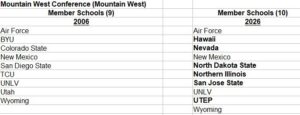
Of the nine Mountain West members 20 years ago, only Air Force, New Mexico, UNLV, and Wyoming remain. Let’s review the teams which have come aboard since 2006.
Hawaii – The Rainbow Warriors (2012) have posted winning football records in just four of their 14 seasons in the Mountain West. The other athletic squads are nearly invisible in the post-season tournaments. Hawaii remains a dream road trip destination for visiting teams and their fans, though. Grade: C-
Nevada – At least the men’s basketball team has appeared in the NCAA March Madness event five times over the past nine seasons. Otherwise, fans of the Nevada Wolfpack (which joined the Mountain West in 2012) haven’t had much to howl about lately. Grade: C-
North Dakota State – This former FCS division powerhouse football program is stepping-up to play against the big boys beginning this fall. The move is for football only.
The Bison are a terrific geographic fit for the Mountain West Conference, too. This makes sense. Grade: A
Northern Illinois – The Huskies will join the Mountain West this fall after 30 years in the Mid-American Conference. Northern Illinois’ sports resume has weakened in recent years. Other than bringing the #3 TV market (Chicago) to the Mountain West, this move makes little sense. Grade: D
San Jose State – The Spartans (members since 2013) have appeared in four bowl games over the past decade. On the other hand, the men’s basketball team has won just 33% of its conference games over the past 13 years. Grade: C-
UTEP – This longtime Conference USA member joins the Mountain West this fall. UTEP’s football team has been downright awful in recent years. Despite a sports slump, UTEP bring strong fan support from the El Paso area. They should be a fine geographic fit for the Mountain West. Grade: C
Mountain West overall grade for expansion: C
Sun Belt Conference (Sun Belt)

The Sun Belt has been nicknamed the “Junior SEC”. This conference has grown from 10 members in 2006 to 14 today.
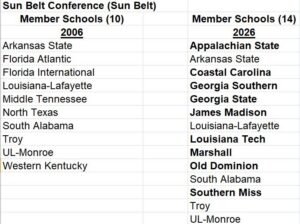
Only Arkansas State, Louisiana-Lafayette, South Alabama, Troy, and UL-Monroe remain from 2006.
Appalachian State – The Mountaineers (members since 2014) have been a top football contender in the Sun Belt. Their enthusiastic fans make road trips to Boone, North Carolina a fun stop. Grade: B
Coastal Carolina – Speaking of fun stops, how about a visit to Myrtle Beach to play Coastal Carolina? The 2017 Sun Belt addition of the Chanticleers has been a terrific addition for the conference. Coastal’s football team has played in six straight bowl games. The baseball team won the men’s College World Series in 2016. Grade: A
Georgia Southern – Would it surprise you to learn that the Golden Eagles from Statesboro, Georgia have played in seven bowl games over the past eight seasons? The other sports programs at Georgia Southern need to step it up. Grade: B
Georgia State – The 2013 addition of the Panthers from Atlanta has not added a lot of sports notoriety. However, the men’s basketball program has earned four invitations to March Madness in the past 11 seasons. Grade: C
Louisiana Tech – The Bulldogs paid dearly ($8 million) to escape Conference USA beginning this fall. Louisiana Tech brings several highly competitive sports teams.
They are a perfect geographic addition to the Sun Belt Conference Western division. Grade: A
Marshall – This begins Marshall’s fourth year in the Sun Belt Conference. The Thundering Herd has been a top football competitor and competes well in other major sports. Grade: B
Old Dominion – ODU came into the Sun Belt in 2022. The Monarchs from Norfolk, VA posted a nifty 10-3 football record in 2025. Old Dominion has been relatively quiet in its other sports, though. Grade: C
Southern Miss – The Golden Eagles (Sun Belt members since 2022) have been a dominant team in recent NCAA college baseball post-season tournaments. Last season’s 2025 football team improved from a miserable 1-11 record in 2024 to a hopeful 7-6 mark. Grade: B
Sun Belt overall grade for expansion: B+
Bonus Conference! The newly revived Pac-12 Conference “states” its case in 2026
The most prominent names of the long-time Pac-12 Conference bolted for better TV money into the Big Ten and ACC in 2024. That left holdovers Oregon State and Washington State “homeless”. The Beavers and Cougars have bagged a few top teams from the Mountain West Conference to help them rebuild the Pac-12 starting this fall.
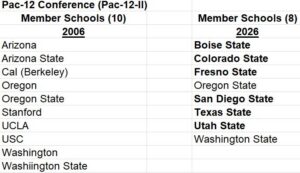
Boise State is the biggest name coming to the new Pac-12. The Broncos have fielded a nationally ranked football program several times in the past few decades.
Other Mountain West migrants include Colorado State, Fresno State, San Diego State, and Washington State.
Texas State (formerly of the Sun Belt Conference) will also join the Pac-12 this fall.
In case you didn’t notice, each of the eight new Pac-12 schools has the last name of “State”!
Summary
Only the Sun Belt Conference has earned a positive score (B+) from SwampSwami among the “Group of Five” mid-major conferences.
The Sun Belt is the only major college athletic conference opting to maintain two divisions (East and West) to minimize travel expenses for its member schools and lessen the travel impact on their student/athletes. Bravo!